
Hello everyone learning Japanese! How are you?
In traditional Japanese month names, October is often referred to as 神無月 (Kannazuki), which is commonly interpreted as “the month when the kami are absent.”
Why is that?
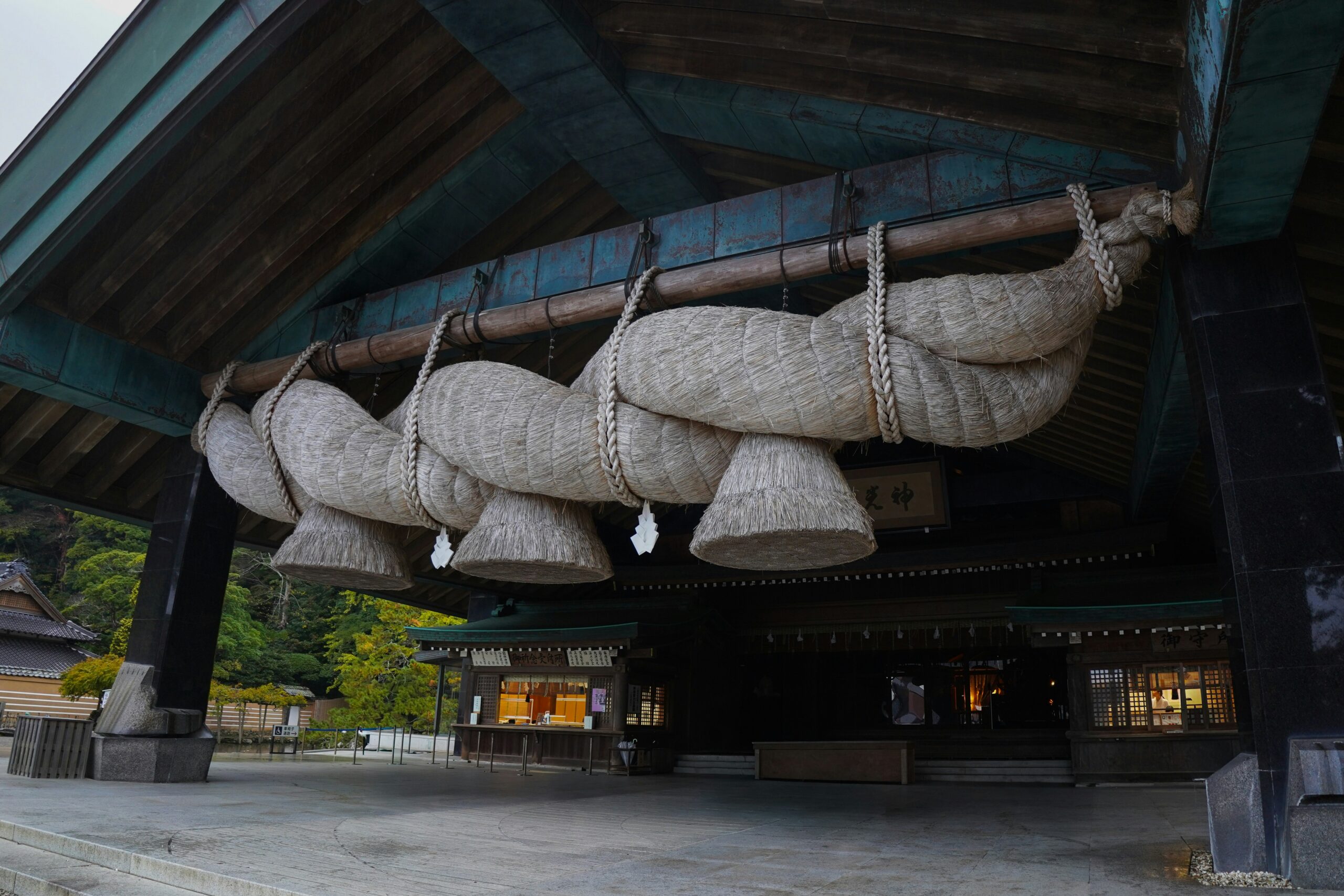
According to a well-known Japanese tradition, the kami (神) from all over Japan gather at 出雲大社 (Izumo Taisha) in Shimane Prefecture. As a result, their usual places of worship are said to be without them during this time.
You might wonder what all these kami do when they get together!
According to the tradition, they gather with the kami enshrined at Izumo Taisha to discuss matters concerning people’s lives, including relationships and the coming year’s harvests. This is also why Izumo has another traditional name for October: 神在月 (Kamiarizuki), meaning “the month when the kami are present.”
Interesting, isn’t it?
Now, you might be wondering why I use the word “kami” rather than simply calling them gods.
In Japanese traditional beliefs, particularly in Shinto, the concept of kami is quite different from what the English word “God” might bring to mind. Kami can be associated with natural features, such as mountains, rivers, and trees, as well as certain places, ancestors, and other things considered sacred.
The expression 八百万の神 (Yaoyorozu no Kami) is often used to describe the countless kami in this tradition. Although it literally contains the number eight million, it doesn’t mean there are exactly eight million. It is an expression meaning “innumerable” or “countless.”
Growing up in Japan, I naturally became familiar with the idea that kami could be present in mountains, rivers, trees, and even things we encounter in everyday life.
I remember my grandmother once telling me, “Don’t leave even a single grain of rice in your bowl. There is a kami in every grain, so you should appreciate it and eat it all.”
For me, this was a lovely way of learning to appreciate food and avoid wasting it.
In this way of thinking, the sacred is not necessarily something distant or far removed from our everyday lives. It can be found in the things around us.
This is one aspect of what is called 多神教 (Tashinkyo), or polytheism, which refers to traditions that recognise multiple deities or divine beings.
In contrast, 一神教 (Isshinkyo), or monotheism, refers to religious traditions centred on one God. Of course, different religions and cultures have their own unique ways of understanding the divine, and even within Japan, people’s relationships with kami vary.
This is also why I find it difficult to translate kami simply as “God” or “gods.” Depending on the context, words such as “deities,” “spirits of nature,” or “spiritual presences” may help convey some aspects of the concept, although none of them fully captures its meaning.
Having grown up in Japan, surrounded by nature, I feel that this traditional way of thinking has influenced how I see the world. It reminds me to appreciate and respect the natural environment and the things that sustain our lives.
Now that autumn is here, it is also a season when we appreciate the harvest and enjoy the abundance of seasonal food. As I enjoy the flavours of autumn, I naturally find myself feeling a sense of gratitude and wonder.
Perhaps, in my own way, I feel connected to this traditional Japanese appreciation of the world around us.
It has become surprisingly chilly here in Tokyo over the past few days, almost as if winter is already approaching!
I hope you are keeping warm, taking good care of yourself, and enjoying the beautiful moments of this season, wherever you are in the world.
See you in November!
Photo by Yosuke Ota on Unsplash

コメント