

What Is Pitch Accent?
Japanese is a pitch-accented language. Pitch accent is a phonological feature that plays an important role in pronunciation and meaning. It refers to patterns of pitch (high and low tones) used in spoken Japanese.
In Japanese, pitch accent can distinguish between words that share the same sequence of sounds but differ in meaning. In this way, it is somewhat similar to stress accent in English, where certain syllables are pronounced more prominently.
However, unlike English stress accent—which relies on loudness, length, and vowel quality—Japanese pitch accent is defined primarily by a rise or fall in pitch. The difference is subtle but essential for natural pronunciation.
There are two basic pitch movements involved:
- Upstep: the pitch rises from low to high
- Downstep: the pitch falls from high to low
Japanese pitch accent varies by region and dialect, but Standard Japanese (Tokyo dialect) is typically used as the reference. In Standard Japanese, there are four basic pitch-accent patterns:
- 平板(へいばん / Heiban) – Flat
- 頭高(あたまだか / Atamadaka) – Head-high
- 中高(なかだか / Nakadaka) – Middle-high
- 尾高(おだか / Odaka) – Tail-high
Understanding the Mora
Japanese uses slight differences in pitch (“high” and “low”) to distinguish words and convey sentence structure. This differs significantly from stress-accented languages such as English.
English is not a rhythmic or timed language, and its basic sound unit is the syllable. Syllables can vary in length, which is why English rhythm feels irregular.
Japanese, on the other hand, is a rhythmic language, often compared to clapping evenly to a beat. Each sound unit takes approximately the same amount of time. For this reason, the basic unit of sound in Japanese is the mora, not the syllable.
This rhythmic consistency sometimes leads learners to believe that Japanese is a “flat” language, but this is a misunderstanding. While Japanese may sound even in rhythm, pitch accent is constantly at work beneath the surface.
Pitch accent can also change depending on surrounding words or sentence context. If pitch accent is not pronounced accurately, speech may sound unnatural or, in some cases, be difficult to understand.
For example, the word はし (hashi) can have different meanings depending on its pitch pattern:
- Heiban: edge
- Odaka: bridge
- Atamadaka: chopsticks
Examples by Pitch Accent Pattern
平板 (Heiban)
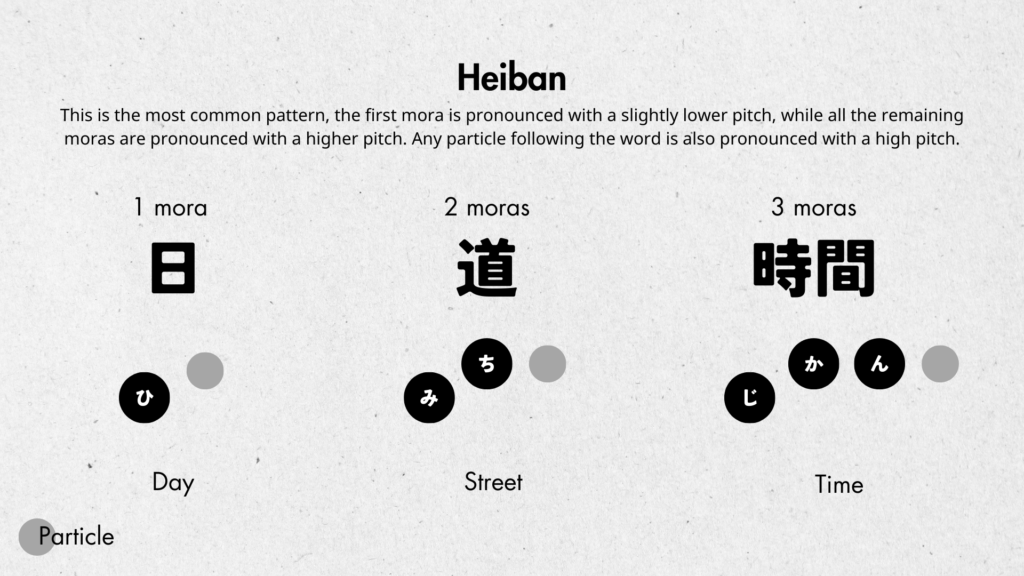
春になって、日が長くなりました。Spring has arrived, and the days are getting longer.
この道をまっすぐ行ってください。Please go straight down this road.
今、時間がありません。I don’t have time right now.
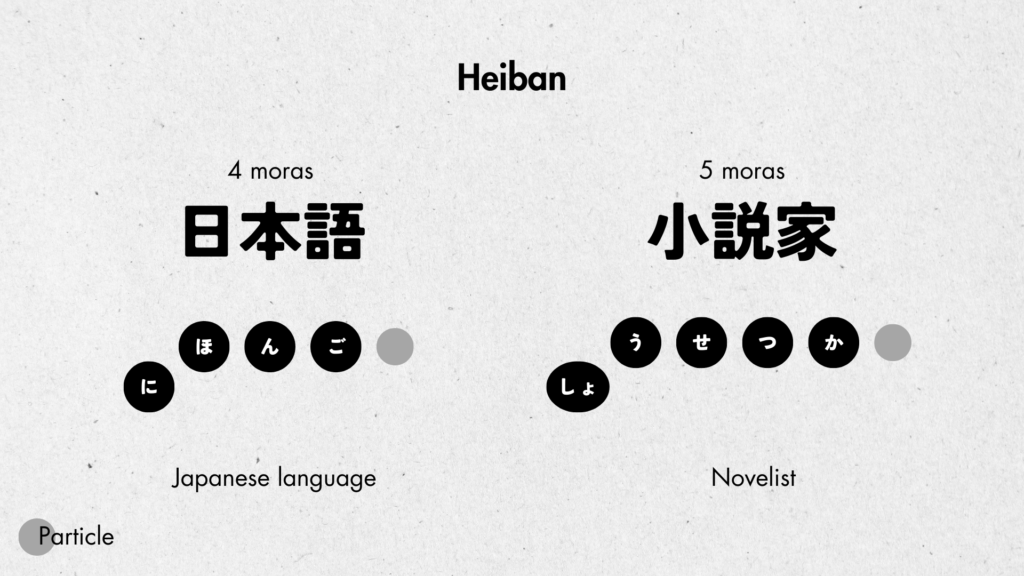
日本語が話せます。I can speak Japanese.
将来、小説家になりたいです。I want to become a novelist in the future.
頭高 (Atamadaka)
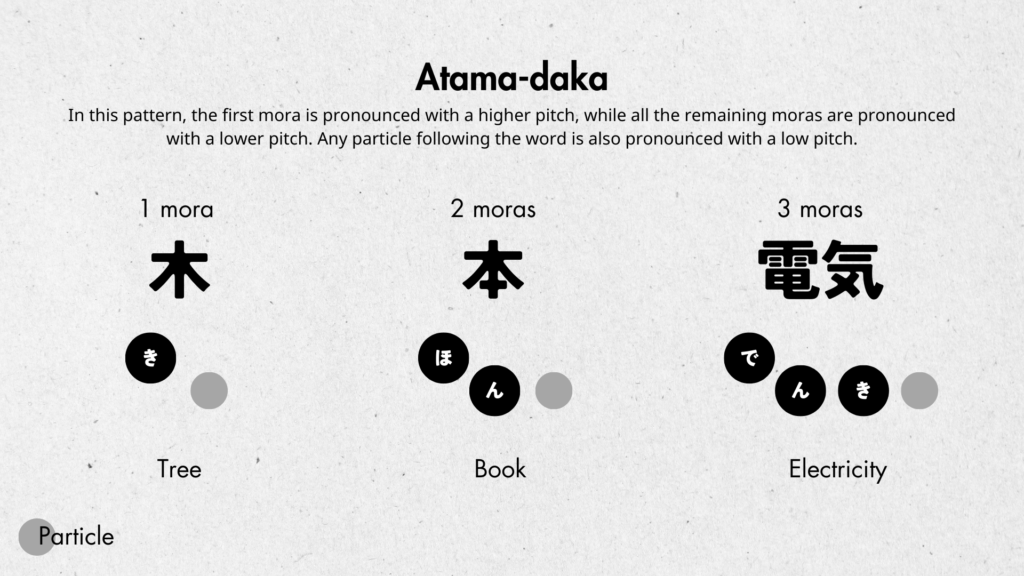
庭にたくさん木があります。There are many trees in the garden.
本を読むのが好きです。I like reading books.
電気を消してください。Please turn off the light.
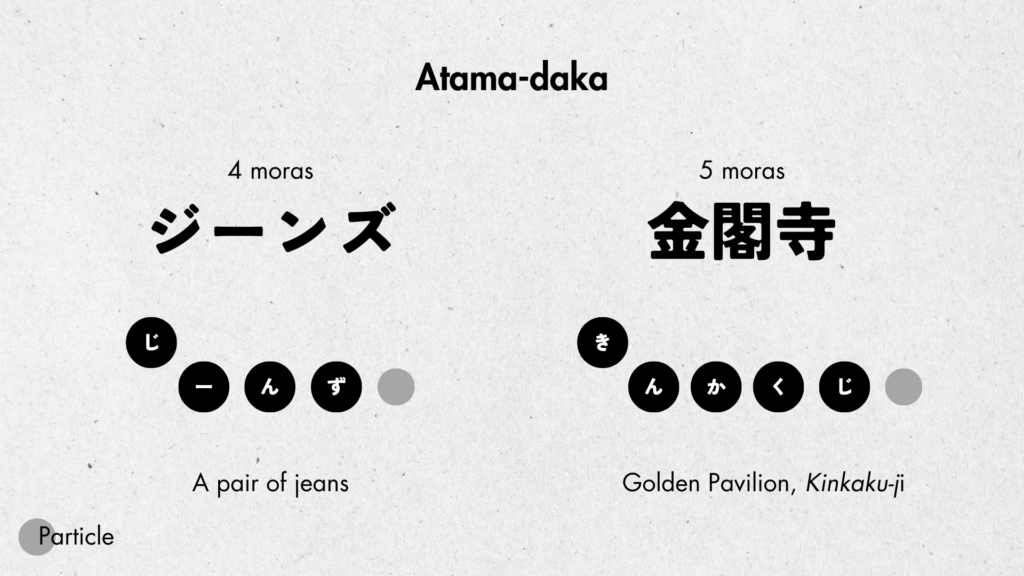
新しいジーンズを買いました。I bought a new pair of jeans.
金閣寺に行ったことがありますか? Have you ever been to Kinkaku-ji?
中高 (Nakadaka)
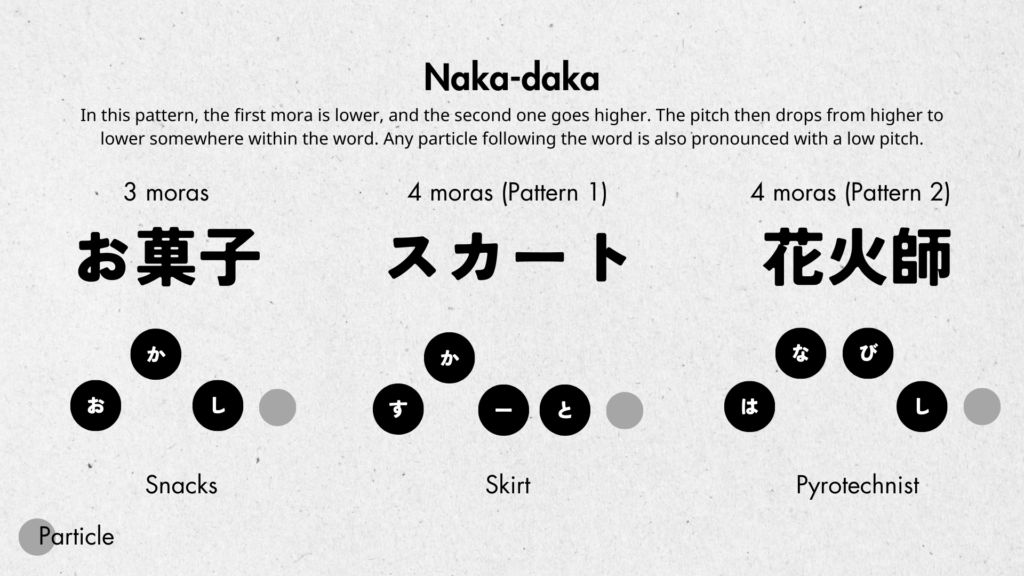
お菓子が食べたいです。I want to eat snacks.
今日はスカートを履いています。I’m wearing a skirt today.
将来、花火師になりたいです。I would like to become a pyrotechnist in the future.
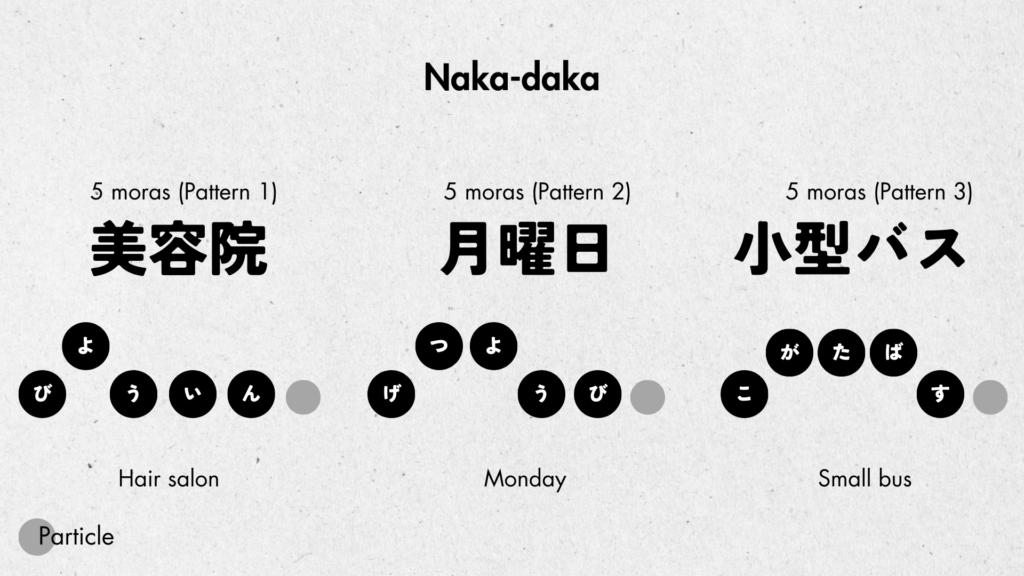
昨日、美容院に行きました。I went to the hair salon yesterday.
月曜日にテストがあります。There will be a test on Monday.
小型バスに乗って観光しました。I went sightseeing on a small bus.
尾高 (Odaka)
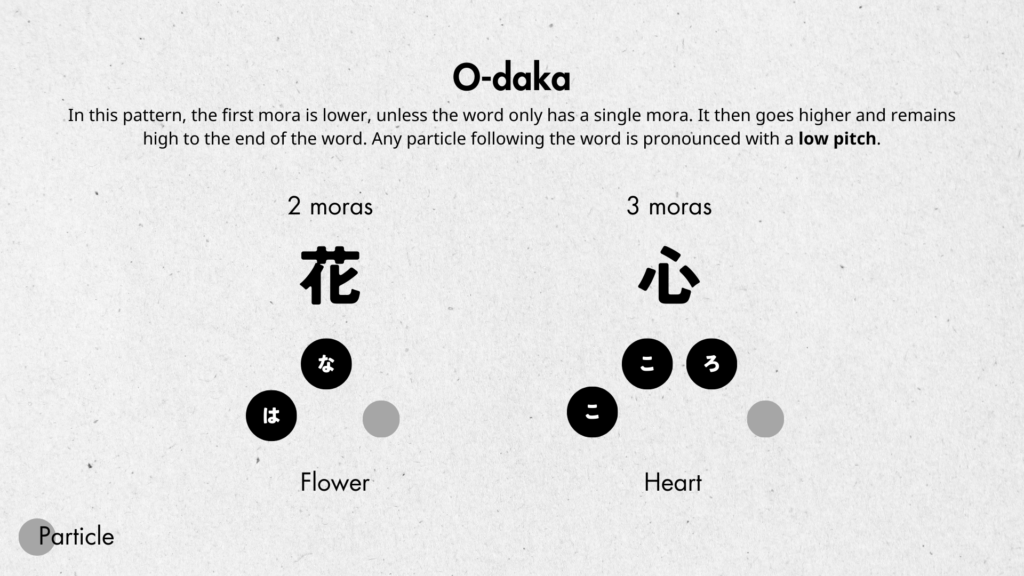
綺麗な花が咲いています。Beautiful flowers are in bloom.
その映画を観て、心が動かされました。I was deeply moved by that film.
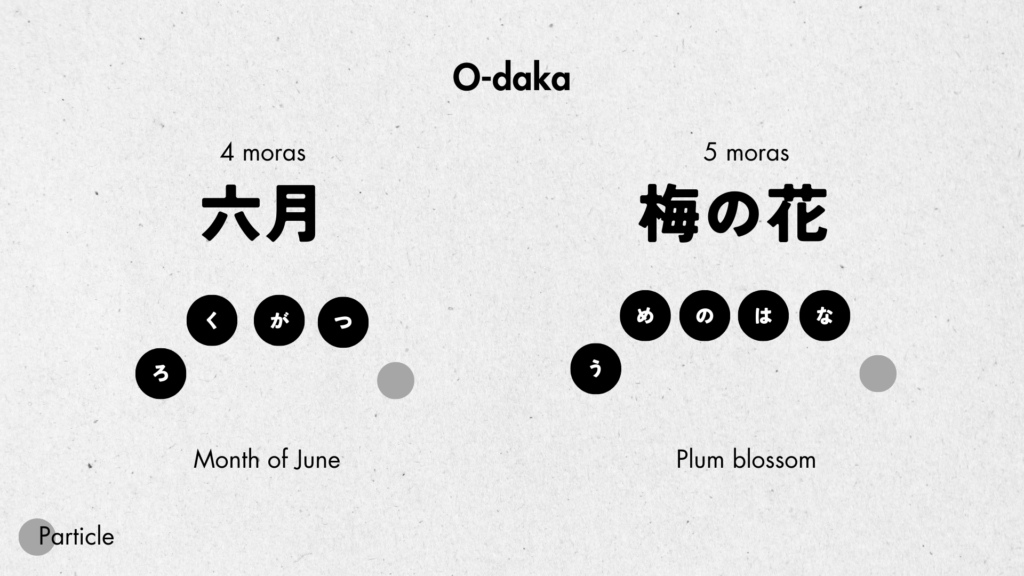
私は六月に生まれました。I was born in June.
二月になって、梅の花が咲き始めました。When February began, the plum blossoms started to bloom.


コメント